
Probably the best known example of columnar basalt around the Bay of Fundy is Balancing Rock in Tiverton, between Digby and Brier Island, Nova Scotia. It only takes about 15 minutes to hike out to the lookoff. Here it's obvious that the original lava cooled into angular columns. You may have heard of the Giant's Causeway in Ireland - one of the world's amazing places to see hexagonal basalt columns. I haven't been there yet but it's on my list!
Wednesday, August 15, 2007
Columnar basalt


Tuesday, August 14, 2007
Molten lava in the Bay of Fundy

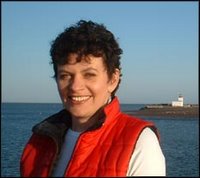
Basalt is the most common type of solidified lava on earth; it actually makes up most of the ocean floor. The Bay of Fundy tides, our constant erosion and our complicated geological history result in a good deal of basalt available here to be 'seen'. Previous readers of my blog will recall references to 'basalt headlands' such as the one over my shoulder at Cape Sharp in Sunday's post two days ago. That's is basalt in its craigy, scarpy form. Basalt also presents here in two other ways: as obvious columns and as rock faces smoothed by the tides. I always think that the smooth basalt looks close to its original molten lava form. I snapped this photo at Cape Sharp beach.
Sunday, August 12, 2007
Hike to Cape Sharp

 Took advantage of the great weather this weekend to hike out to Cape Sharp lighthouse. Cape Sharp is located near the village of Black Rock, overlooking the Minas Channel (near where the proposed tidal energy project may be) near Parrsboro, Nova Scotia. The hike to the lighthouse is about 20 minutes via the old access road. The lighthouse was automated in 1989 so that road is only traversable by foot now. Doesn't bother me - it's well worth it for both the view and the solitude. The lighthouse itself is a salt shaker style, dating from 1886. It stands about 35 feet in height and its light reaches out 11 miles in the upper Bay of Fundy. That's just about perfect because that's pretty much the distance over to Cape Blomidon on the opposite side of the Bay! Luckily the tide was out today enabling me to take this photo looking up to the lighthouse from the beach - at high tide here I'd be way under water. All safe up on the lighthouse though where I stopped to explore the panoramic view.
Friday, August 10, 2007
Tidal energy info sessions start Monday
Just heard that the Offshore Energy Environmental Research Association will hold a series of six environmental assessment community forums starting next Monday.
The forums will provide an opportunity to share information about the potential to generate tidal energy in the Bay of Fundy using tidal in-stream turbines.
"The Bay of Fundy may be the best location in the world for grid-connected tidal power generation, but this form of renewable energy technology is still very new," said Meinhard Doelle, chairman of the Fundy Tidal Energy Technical Advisory Group.
The forums will run from 7 to 9 p.m. The dates and locations are:
August 13, Monday, Yarmouth, Rodd Grand Yarmouth;
August 14, Tuesday, Digby Pines Golf Resort & Spa;
August 15, Wednesday, Wolfville, Acadia University;
August. 20, Monday, Parrsboro, Fundy Geological Museum; Aug. 21,
Truro, Best Western Glengarry Hotel; Aug. 22, Halifax, Dalhousie University.
Pre-registration for the forums is available at Offshore Energy Research office (click on Events) or by calling Wanda Barrett at 1-888-257-8688. For more info on tidal energy in the Bay of Fundy see the sidebar of my blog.
Actual site of highest recorded Fundy tides


Yikes! I neglected to mention one more very interesting location for seeing the tides around the Bay of Fundy: the site where the highest tides in the world measurement was taken! The record was set at Burncoat Head, near Maitland, Nova Scotia. Burncoat Head Community Park consists of a great little park and restored lighthouse/interpretive centre. Here you can walk on the beach at low tide, view the tides from the lookoff, and explore the many smooth sandstone rock formations. The rock formations are so intriguing here that Burncoat Head looks like a moonscape (see photos). All rock formations become small islands at high tide of course. The normal tidal range here is about 15 metres or 50 feet. The record here is 17 metres or 56 feet.
Wednesday, August 08, 2007
How to 'see' tides - 4th way
 4) One other way to see the tides is to visit a location where the tidal rapids, whirlpools or rips can be seen. The Bay of Fundy coast is definitely not smooth and linear; there are many craigy cliffs and sharp headlands jutting out into the Bay and, I supppose, in some ways interfere with the flow of water in and out of the Bay, or at the very least cause the water to flow in interesting patterns.
This is a photo of the "Old Sow: the largest whirlpool in the western hemisphere, the second largest in the world - second only to the Maelstrom Whirlpool of Norway. Located between Deer Island and Indian Island, this natural wonder can be seen from the shores of Eastport, Maine. It is called “Old Sow” because of the sounds that are heard from the churning waters. The best time to see the "Old Sow" is 3 hours before high tide.
Other places to see tidal rapids and rips include:
in New Brunswick
- by boat in the Passamaquoddy Bay (such as off the coast of St Andrews or between Black's Harbour and Deer Island)
- Reversing Falls in Saint John
- Cape Enrage
- Cape d'Or near Advocate
- Cape Split - it's a 4 hr hike out there (near Wolfville)
- in the water passages of Digby Neck and Islands: Long Island, Brier Island
Monday, August 06, 2007
How to 'see' tides - 3rd way

 3) Vertical Tidal Effect - This is the effect seen at most of our wharves around the bay. This is also best seen at high then low tide but if you are really stuck and can only visit for an hour or so, plan to visit at low tide. At low tide local fishing boats are sitting high and dry on the ground against the wharf while the tide is a mile or so away. Or at low tide thick gooey riverbanks and riverbeds of mud are exposed. See photos in the high-low photo section of my blog.
Some of my favourite harbours where this can be seen...
in New Brunswick:
- Alma, St Martins, Hopewell Cape, the Chocolate River near Hillsborough, Petticodiac River in Moncton, Sackville
- Advocate Harbour, Parrsboro, Hall's Harbour, Margaretsville, Harbourville, Digby
Thursday, August 02, 2007
How to 'see' the tides - 2nd way

Here's another way to 'see' the tides...
2) Horizontal Tidal Effect - this phenomenon occurs in many locations in the upper part of the Bay of Fundy but you need to allow 6 hours to appreciate it. Basically, it involves going to the same beach at both high and low tide to see the difference. If you are accustomed to the 1-6 foot tides in the rest of the world, this may not sound very impressive. However, with the volume of water we have moving in & out of the Bay (100 billion tonnes each tide, 50 ft tides) the horizontal effect can be a truly an amazing sight!
At low tide a vast expanse of the ocean floor is exposed. In the upper part of the Bay the tide can be a few miles away from where it was at high tide. And, of course, there is nothing like sea kayaking at high tide over where you were previously walking at low (see links).
Here are a few of my favourite places to explore the horizontal effect:
In New Brunswick...
- St Martins - eat 'world's best chowder' at the waterfront restaurant, explore the ocean floor and sea caves at low tide. Seakayaking available. You can also get out onto the beach at the Fundy Trail or at least see the intertidal zone from its various accessible lookoffs.
- Alma - explore the intertidal zone (that's what we call the exposed ocean floor) carefully on your own or take in a program there at Fundy National Park. Sea kayaking.
- Hopewell Rocks - the Rocks (as we locals call 'em) are probably the most photographed image of the Bay of Fundy. There is a great interp centre here as well as many acccessible lookoffs and, of course, access to the ocean floor and the famous 'flower pot' sea stacks. Seakayaking here too.
- Joggins - one of the coolest things about low tide at Joggins is the exposure of a vast expanse of fossils and geological reefs. Previous blog readers may remember me mentioning that the Joggins Fossil Cliffs will soon receive UNESCO world heritage site status. There is a fabulous new interpretive centre under construction there - should be open this fall. There is still beach access there now but it kinda helps to be with staff so you know what you are looking at! Kayaking in nearby Advocate.
- Five Islands - the stretch of Route 2 from the village of Economy, through Five Islands then to Parrsboro is one of the best places to see the vast intertidal zone. Here both Five Islands Provincial Park and Two Islands (near Parrsboro) are not surrounded by water at low tide. Recent readers will recall me mentioning the 'new' Not Since Moses' running event around the Five Islands at low tide. Don't try this without a guide!
- Grand Pre - One of the most easily accessible Bay beaches Evangeline Beach near Grand Pre, Nova Scotia. Grand Pre is the village near Wolfville. The nice thing about visiting Grand Pre is that during the 6 hr interval there is lots to do in the area. There is a national historic site in the village of Grand Pre itself - recalling the history of the Acadians (our French settlers who were expelled in the 1780s). This is also Nova Scotia wine country; there are several wineries in the area - one , the Grand Pre Winery, right in Grand Pre.
Tuesday, July 31, 2007
How to 'see' the tides - 1 way
 Speaking of questions from folks, this is probably the question Bay of Fundy-ites get asked the most: "Where can I go to 'see' the tides?". The answer to this question is more complicated than you may think. Over the next few days I will give you my best four answers to this single question.
1) Tidal Bore - even if you've never been here before, you'll probably have some pre-awarenss of the phenomenon known as the tidal bore: outflowing rivers flowing back upstream as the tide comes in. Folks who have never been to Fundy before tend to take our 50 foot tide measurement and combine it with the bore concept - then end up thinking that we have a 50 foot (think: tsunami!!) bore twice a day, which we do not. The actual rapids of a tidal bore range between about 10 to 12 feet which is still pretty cool.
Many rivers in the upper part of the Bay have tidal bores but, unless you're a local, you may have trouble finding them. Visitors usually like to visit those with some interpretation. Most of these are on the Nova Scotia side of the bay. I'd suggest:
1) the Maccan River about 10 minutes from Amherst where there are interpretive panels,
2) the tidal bore in Truro just out by the Palliser restaurant
2)the South Maitland Tidal Bore Lookoff where there is an interpretation centre and some panels.
Note that the bore time does not match either the high or low tide times listed on the tide chart for that community. The bore time varies depending on where you're perched to view it from the riverbank.
Personally, I think the best way to experience this tidal change is to go white water rafting in it...it's interesting to watch from the shore but it is hugely fun to raft in. If this is your kinda thing there are two companies I can recommend - I've gone with both: Shubenacadie River Runners and Shubenacadie Tidal Bore Rafting Park. They are located in the village of Maitland about 40 min from Hfx airport in the opposite direction from Halifax. so that'a about 1.5 hr from Halifax.
Friday, July 27, 2007
How to read the Bay of Fundy tide chart
I had an email from someone in Texas this week. They were looking for some tips on how to read a tide chart. This is, in fact, a bit tricky so I'm happy to explain:
1. Best source of tide times (in my opinion) - The Canadian Hydrographic Service, Dept Fisheries, You can zoom in on a map for any geographic area in Canada.
2. Then you can choose a community & the dates you want to visit from the menu bar.
A chart like this will pop up. This chart (for Parrsboro) is saying that low tide today is at 5:16 am and then again at 17:30 (5:30 pm). High tide will be at 11:26 (it will be a 33.8 ft tide), then high tide will be back at 23:44 (11:44 pm) - a 36.7 foot tide.
| 2007-07-27 (Friday) | ||
| Time | Height | |
| ADT | (m) | (ft) |
| 05:16 | 2. | 9.2 |
| 11:26 | 10.3 | 33.8 |
| 17:30 | 3.1 | 10.2 |
| 23:44 | 11.2 | 36.7 |
Wednesday, July 25, 2007
A Bay of Fundy Plein Air Paintout

Just heard of an interesting event happening around the outer edge of the Bay of Fundy this week: a Plein Air Paintout! Twelve artists from the Bay of Fundy region are participating in this 'first annual' event. Painting is happening in situ in Lubec, Maine, and on Campobello Island, NB, among other lovely Fundy coastal spots. Art created from the paintout will be exhibited at historic Mulholland Market in Lubec until August 25.
This is one of participant & instructor Micheal Chelsey Johnson's pieces that was created during the paintout this week. Here's how Michael describes the scene:
The tide went out while we worked, and the clamdiggers showed up with their big wheelbarrows and high boots to work in the mudflat. (I did not include the clamdiggers in my piece.)
Check out other Fundy Plein Air artists in the Art section of my blog.
Sunday, July 22, 2007
Conquering Red Rocks!
 A glorious day today on the Bay of Fundy! We had company this weekend and did what any Fundy-ite does: took 'em to the beach. We had fun at "Red Rocks" just inside the entrance to Cape Chignecto Provincial Park in Advocate Harbour, NS: clambering up and over these smooth but abrupt rock formations.
If you want to be assured of taking photos that always look 100% perfect, there is no better subject than the contrast between sandstone boulders and blue sky. This is a photo of me "conquering" one of the higher ones - Terri on top of the world!!
Tuesday, July 17, 2007
Introducing the mudflats
 Last, but not least among the five types of Bay of Fundy beaches, allow me to present the often under-appreciated mud flat. Personally I think there is nothing better than Fundy's red/brown mud sklooshing up to swallow my running shoe or, even better, slicing between barefoot toes. Em, don't look took closely at the mud though - there are microscopic shrimp in there, a critical food source for our migratory shorebirds!
Monday, July 16, 2007
Introducing the pebble beach
 Fourth in my series of beachscapes around the Bay of Fundy is the pebble beach. Here the rocks are about the size of almonds and peas; far smaller than the cobble beach. Pebble beaches combine with sand to make for easy walking along the ocean floor at low tide. Sometimes, like here at Second Beach, pebbles can 'transform' into mudflats - your best running shoes are not always the best choice for foot attire here!
Sunday, July 15, 2007
Introducing the sand bar beach
 Bay of Fundy tidal turbulance often whips the lighter bits of the ocean floor into sand dunes or sandbars. At low tide these are great fun to explore but they're also an easy way to get marooned by the incoming tide. Sandbars like this one at Second Beach can quicky become an islands and, as the tides continue to rise, soon covered with 30 to 40 feet. It's always best to know accurate high/low tide times and be 360 degrees aware when you explore the Bay's many beaches.
Saturday, July 14, 2007
Introducing the reef beach
 The formal definition of a reef is a ridge of rock just below the surface of the water. Reefs around the coast of the Bay of Fundy are below the surface at high tide then fully exposed at low tide. This is a basalt reef at Second Beach. The exposed edge of basalt (a normally angular volanic rock) is slightly smoothed by the daily tides and becomes welcome habitat for various Fundy seaweeds, perwinkles and other small creatures.
Friday, July 13, 2007
Introducing the cobble beach
 Here around the Bay of Fundy there are about a half dozen types of beaches. Many beaches, particularly at low tide, have a combination of beach terrains including: cobble beach, sandy or sand barred beach, reefed beach, pebble beach and mud flats.
I think I'll run a 5-day series of photos I took last weekend at one beach: Second Beach in Parrsboro, Nova Scotia. All five types of beach terrain appear within a 100 metres along this one beach!
Today's photo shows a cobble beach. From a geological point of view cobbles are round and oval rocks measuring between 3 and 10 inches in diameter. Most folks would be familiar with ocean or river cobble stones being used to make sidewalks or hearths.
Don't let cobbles deter you from exploring the beach. They are a bit tricky to walk on but often you'll need to traverse a band of cobbles to get further on to the ocean floor so it's well worth it!
Tuesday, July 10, 2007
More funds for Bay of Fundy tidal energy
 Just heard today that a Bay of Fundy tidal power pilot project proposed by Nova Scotia Power and its Irish partner Open Hydro has received a $4-million shot in the arm from Sustainable Development Technology Canada.
The project cost to install an in-stream turbine on the bottom of the Bay of Fundy is expected to be $12-million.
This project will involve comprehensive environmental and oceanographic monitoring of a turbine placed in some of the strongest-known tidal currents in the world. (see map for places in the world that Open Hydro has identified as having the best tidal power potential - I marked in the Bay of Fundy).
The first Fundy turbine would produce one megawatt of electricity, enough to power 300 households. The project must still receive provincial environmental approval. The partners hope to have it operating by 2009 and test its operation in the following two years.
I'm continuing to follow this quite closely from my front row seat here on the Bay of Fundy, near the proposed tidal energy staging area - see sidebar for previous posts about tidal energy.
Sunday, July 08, 2007
Bay of Fundy birth annoucement (of whales, that is)

The Bay of Fundy has become a bit of a nursery lately with the arrival of ten humpback mothers with their calves. Humpback whale calves are born in the Caribbean after a 12 month gestation. They drink about 50 gallons of milk from their mother, gaining several hundred pounds per week. They stay with their moms for about a year after they have been weaned at the Northern feeding grounds. Visit Brier Island Whales & Seabird Cruises blog to find out more.
This is a photo Foggy's tail fluke. Foggy had her first calf, Sparkler, in 2000 and her second, Motley, in 2003. Her 2007 calf will not be named until it makes its return to the Gulf of Maine after it leaves its mother.
Thursday, July 05, 2007
"Not Since Moses" run across the ocean floor

 Just when I thought I'd heard everything along comes a new, wildly zany yet oddly spiritual event: the first annual Not Since Moses run across the Bay of Fundy's ocean floor.
Happening this Saturday, July 7, in Five Islands, Nova Scotia, the aptly named Not Since Moses is reminiscent of Moses' biblical parting of the Red Sea. For awhile at low tide the ocean floor linking the islands to the coastal village is fully exposed (see photo). This, with proper planning and guidance by a local, is enabling a fully organized 10 k run and a 5 k walk. Yikes - don't ever try this on your own!!
Owner of one of the islands, Dick Lemon, is the originator and organizer of the event. Lemon, from California, purchased Long Island in 2003 to build Five Islands Retreat, a “restorative place for writers, musicians, artists and other interesting people.”
I chatted with Dick this week about the run. He's convinced the Not Since Moses will become a world famous running event and, after hearing more about it, so am I!
Friday, June 29, 2007
Where the wild peas grow
 Where else would you expect to find copious amounts of wild peas but beachside around the Bay of Fundy? Took this photo of pea blossoms this afternoon. I've heard that our first nations, the Mi'kmaq, used both the peas and blossoms for medicinal purposes.
Wednesday, June 27, 2007
Historic John Lusby Marsh
 Whoa, I knew I'd really caught the photography bug when I snapped this photo out of my car window while driving this week. This is a cheery, somewhat unsung spot on the Bay of Fundy: the John Lusby Marsh located on the Cumberland Basin just west of Amherst, Nova Scotia.
This marsh has the distinction of being the largest continuous tract of salt marsh remaining in the upper Bay of Fundy. The 1020-acre marsh was diked by Acadian settlers about 300 years ago. Much of the marsh is still farmed although some has returned to salt marsh conditions due to erosion of the historic dikes. Lusby Marsh is a National Wildlife Area under the Wildlife Area Regulations of the Canada Wildlife Act.
The wildlife area consists of John Lusby Salt Marsh and Amherst Point Migratory Bird Sanctuary, two very different wetlands, and separated by a narrow, 1 km-wide upland ridge. I was driving on road across this ridge when I snapped this photo.
Monday, June 25, 2007
Rafting the tidal bore

 A list of cool things to do around the Bay of Fundy would be incomplete without mention of another of our zany water sports: rafting the incoming tidal bore. This is sort of the same idea as jet boating Reversing Falls mentioned in a previous post. The incoming Fundy tide creates a roller coaster of turbulance when it meets the flow of outgoing rivers. There are many tidal bores on rivers of all sizes around the Bay but the Shubenacadie River, near Maitland, Nova Scotia offers the full rafting deal. Zodiacs are the boat of choice; quickdry fabrics the garb of choice (well actually, float suits are superb in May and October). This experience involves weaving in and out of the tidal rapids for a 2-hr or 4-hr adventure.
I've gone tidal bore rafting with two excellent companies: Shubenacadie River Runners and Shubenacadie Tidal Bore Park. They've both got great facilities and energetic, qualified staff to lead the rafting experience. It's a blast!
Saturday, June 23, 2007
Walking the Saint John waterfront

 One of the other great activities to do in Saint John is to explore the newly reclaimed "Harbour Passage" waterfront trail system. It's a beautifully crafted set of walking/cycling trails all along the harbour's edge. The trail also includes lookoffs, interpretive panels, benches and great places to stop to read the paper, watch the tide come in, or the fog lift. I took these snaps early this morning while I was one of a few walkers out enjoying the views!
Thursday, June 21, 2007
Beach volleyball anyone?
 This has to be right up there on my list of cool stuff to do around the Bay of Fundy: playing beach volleyball on the waterfront in Saint John. Someone with a great eye for opportunity carved out a half dozen beach volleyball courts in the historic heart of the city across from a bunch of restaurants & pubs with boardwalk patios. I caught some players 'in action' when I walked around the SJ waterfront at dusk.
Wednesday, June 20, 2007
View from the upper deck
 I snapped this pretty pic as we left the Digby (NS) harbour heading for Saint John (NB) aboard the Princess of Acadia ferry. This is a grand 3-hr trip (think: mini-cruise) across the Bay of Fundy. Maybe its because my ancestors were shipbuilders here in the Bay but, to me, no vacation is complete without some contact with water!
As I mentioned in a March post, this ferry is getting a refurb. New passenger comforts, high-speed internet, Starbucks, Bay of Fundy intepretive program, etc. Folks who live around the Bay are excited about this makeover. The changes are being unveiled tonight during a special evening cruise from Saint John and on Saturday with an open house event in Digby. I'll be taking in the festivities tonight - whooo hooo!
Many forms of dulse

 I'm working in Saint John, New Brunswick, this week and noticed that one of the vendors at the City Market had a great variety of dulse and dulse flakes (teensy dried up bits of dulse in a shaker). I even discovered a new product: dules flakes with garlic. A bit further down into the market were the more traditional paper bags of loose dulse for sale. Delish!
Tuesday, June 19, 2007
Got dulse?
 Previous blog readers will know I'm crazy about dulse - our edible Bay of Fundy seaweed treat. It's dulsing time now at various locations around the Bay . Dulse harvesters are venturing out in their small open boats at 4 and 5 a.m. these days, depending on the tides, to pull in loads of the tasty seaweed.
Dulse can be taken from the same rocky bed every two weeks — it grows that fast — and is one of the few remaining sea products whose harvest is not regulated by government.
Wanda VanTassel of Gullivers Cove on Digby Neck is up to her elbows in the purple seaweed every day.
She owns Fundy Dulse, a company that harvests, packs and sells dulse and stuff made from dulse, like dulse flakes and even dulse soap. Wet dulse loses about 50 per cent of its weight while drying.
Dulse, which is rich in iodine and minerals, contains some protein and has been used for everything from folk remedy to snack food. After the dulse is harvested, it is cleaned of things like shells and sticks and delivered to the drying grounds where it is spread out. On a good day, it can be picked up for packaging after four or five hours in the sun.
Click here for my previous posts on dulse.Sunday, June 17, 2007
Meet another Bay of Fundy artist
 The Bay of Fundy certainly seems to encourage creativity among its residents. I recently met a Bay of Fundy fibre artist in the blogsphere: June Cable. June recently opened a new studio gallery in Pennfield on the New Brunswick side of the bay: Wizard of Felt.
Here's a photo of her marvelous work: a wall hanging of lily pads at Canal. Canal, a crossroads-sized commuity, just outsdie St George is one of only two natural canals in the world, the other is somewhere in China. Our Canal flows between Lake Utopia and the Magaguadavic River (which, of course, flow into the Bay of Fundy at St George).
I love it....a geography lesson thru art!
Thursday, June 14, 2007
Two provinces fund tidal power study
 It's been a few months since I've had anything to report on the potential of tidal power development in the Bay of Fundy. Interesting news this week, though: New Brunswick and Nova Scotia have just announced that they are jointly funding a study that will bring marine renewable power generation one step closer to reality.
The two provincial governments will each invest $75,000 in a strategic environmental assessment of tidal power in the Bay of Fundy. The assessment will include a comprehensive consultation process with organizations and groups with an interest in the future of tidal power in the region as well as a socio-economic impact assessment report.
The Offshore Energy and Environmental Research Association, a group of Nova Scotia universities established and funded by the provincial government to study the sector, will be responsible for carrying out the request for proposal process.
When the final report is back in the governments' hands next year, the energy ministers will have a better idea of the background of the competing tidal technologies on the market and the potential impact on the environment. And that information will serve as a starting point for the public engagement process to solicit concerns from groups such as fishermen, the shipping industry and the tourism sector.That's a great step forward for what could possibly be the greenest form of energy on the planet.
(photo: NASA image from space of Minas Basin, Bay of Fundy, high-low tide - one of the possible tidal energy sites),
Wednesday, June 13, 2007
Prince Henry was here...or was he?

 Bay of Fundy legend has it that, in 1398, Prince Henry Sinclair, Earl of the Orkney Islands (Scotland) became the first European to visit the 'new world'. This is about a hundred years before other, more famous explorers: John Cabot in 1494 and Christopher Columbus in 1492/98. The owner of the little cottage at Partridge Island had a bit of fun crafting a cairn to Prince Henry, equipt with a celtic cross and all!
Tuesday, June 12, 2007
A wee faerie cottage on the Bay
 There is a curious little cottage bordering the salt marsh on the Partridge Island beach (near Parrsboro). This wee cottage, about 10 ft x 10 ft, sits up brightly behind a homemade dyke designed to keep the higher tides away. Creative design, local stones and wildflowers make a faerie-like oasis here at the edge of the Bay of Fundy. I thought this made a fine addition to my new 'architecture' blog category...more to follow over the coming weeks and months.
Sunday, June 10, 2007
Feedback for CBC
It appears that the people continue to speak with regard to the puzzling CBC 7 Wonders results: click here to read Canadian comments on the CBC blog. I'm clearly not alone in my support of the Bay of Fundy!
Saturday, June 09, 2007
Not so wonder-ful Bay of Fundy?
 Ewwww, a panel of judges has conferred and despite the Bay of Fundy placing third among Canadians in popular vote, oddly we didn't actually made the final list of Canada's 7 Wonders. Admittedly, quite a few really great places & things received the honour: Pier 21 in Halifax, Niagara Falls, The Rockies, Old Quebec, Prairie skies, the igloo, and the canoe.
So, in celebration of this CBC contest (which really did succeed in raising awareness of so many great places in our country), I'm posting the following compromise: a historic photo of a Mik'maq canoe traversing the Bay of Fundy. So there!
Thursday, June 07, 2007
Celebrating Environment Week Fundy-style

 Here is an interesting way to celebrate Nova Scotia's annual environment week: buy the most environmentally friendly outboard engines available! Well, that really is a good choice for a whale watch tour operator. Tom Goodwin of Ocean Explorations Zodiac Whale Cruises in Tiverton, NS, is starting his 2007 season with brand new Honda four stroke outboards (ultra low emission)! The company regularly "refreshes" the outboards for both dependability and reduced impact on the environment.
Biologist Tom's Ocean Explorations Zodiac Whale Cruises business is one of the most environmentally friendly with whom I've ever come in contact. Tom owns the original hybrid car (2000 Honda Insight), buys wind energy, the business has solar heating, and donates alot of money to environmental and conservation groups (well before 'green became keen' in the past few months).
P.S. That's humpback whale flipping up its pectoral fin beside Tom's zodiac!!
Wednesday, June 06, 2007
Weir fishing video
While at the fish weir on the weekend I also caught some video. Take a look at this video of the guys in action:
Monday, June 04, 2007
Bay of Fundy weir fishing FAQs
 I chatted for awhile with owner, Alan, as he watched his guys scoop up the catch. Although this weir is probably one of the Bay of Fundy's best kept secrets, Alan notes that tourists often happen upon it then ask an interesting slew of questions. Here are the weir FAQs with answers:
1. What types of fish are caught in the weir?
Herring first (May, early June) then Mackeral and Shad
2. Does the weir operate yearround?
No, the fish run in the spring and early summer. The weir is not fished in the warmer weeks of summer (later July and August). Before winter, the nets are completely removed to avoid damage by ice cakes. The nets are re-strung in April.
3. Do you need a license to have a weir?
Yes, Alan has a Dept of Fisheries license just like any other commercial fisherman. This insures that no other weir is set in close proximity. Alan has carried the license in this location for about 20 years but a weir in this location dates back to about 1880. There are a couple other small weirs about 15 miles away in Five Islands but no others anywhere nearby.
4. How much time do you have to get the fish out before the tide comes back in?
This varies with every tide (the highest tide times of the month are also the lowest tides) but generally the boys are in the weir with their hip waders about an hour before low tide and an hour after it.
5. After all the fish have been scooped why is the floor of the weir swept free of fish scales, etc.
Over the years Alan has noted that if he does not "clean the barn" with each tide then he does not catch any fish on the next tide. It's almost as if there is a bad vibe for the fish with a mess around.
6. Do you ever catch anything else in the weir ? Occasionally a few other types of fish are caught, like cod, but this weir has been purposely designed to follow the natural instincts of herring and mackeral. As the tide rises they swim across the shoreline until they are guided by the weir's nets into its figure-8 section. Herring and mackeral naturally swim in a figure-8 pattern so they are content to swim around in the weir without venturing back out the wide opening. Sea mammals such as seals or porpoises would figure out how to leave 'by the main entrance' and are therefore not caught. If they were, the weir is equipt with a handy trap door at its base on the water side that would enable their safe release.
Sunday, June 03, 2007
Netting the catch

 As luck would have it, I timed my dog walk to the beach perfectly today to watch the weirmen netting their substantial haul from the weir. Once the fish are drawn in by the weir they are gathered by hand net, boxed and shipped immediately as much-desired bait for lobster traps.
Here's a closer photo of one of the weirmen scooping the herring and dropping them into the crates. As usual, the guys mused at my perennial fascination with this historic tradition yet kindly insured that I had a couple fresh herring in a grocery bag to take home for breakfast.
Bay of Fundy fish weir at low tide

 Further to last week's road to nowhere photos showing the mysterious route to our local fish weir at high tide, here is the same set of photos at low tide. There has been a weir in this location since the late 1800s. Fundy's strong tides and winter ice cakes mean it has to be rebuilt each spring. After several weeks of weir repairs this spring it is now back in full swing and the catchs are great.
Friday, June 01, 2007
Bay of Fundy - NASA image of the day from space!

 Here's an up-to-date satellite image of the Bay of Fundy from space: taken just two days ago. You can practically see the grass growing! Every day NASA selects a favourite satellite image to post on their website; it was the lovely springtime Bay of Fundy this week.
We're all getting quite used to seeing satellite images (especially since the invention of Google Earth). However, NASA (through the MODIS program) was probably the first to get such photos out into general cirulation in the early days of the internet.
MODIS (or Moderate Resolution Imaging Spectroradiometer) is a key instrument aboard the Terra and Aqua satellites. Terra's orbit around the Earth is timed so that it passes from north to south across the equator in the morning, while Aqua passes south to north over the equator in the afternoon. This means that Terra MODIS and Aqua MODIS are viewing the entire Earth's surface every 1 to 2 days acquiring data.
MODIS plays a vital role in the development of global, interactive Earth system models able to predict global change accurately enough to assist policy makers with making sound decisions regarding the protection of our environment.
Wednesday, May 30, 2007
Mussels with Ginger-Pesto
 Ginger-Pesto Mussels
Further to my series of mussel recipes, here's one that includes two of my other favourite foods: pesto and ginger.
INGREDIENTS
4 1/2 lbs mussels
4 oz dry white wine
2 cloves garlic, crushed
4 thick slices blackforest ham (optional), chopped in small chunks
3 oz fresh white breadcrumbs
2 Tbsp pesto
2 Tbsp grated ginger root
Scrub the beards off the mussels. Soak in cold water for 5 minutes, drain, repeat. Discard any open or damaged mussels. Place in a large saucepan with the wine and garlic. Cover and cook at high heat for three minutes or until the mussels open. Shake pan occasionally. Remove mussesl from pan, reserving the cooking liquid. Discard the top shell from each mussel and arrange the mussels on the half shell in a shallow dish or baking sheet. Strain the mussel liquid through cheesecloth. Combine the ham, breadcrumbs, pesto and ginger and stir in 1 to 2 Tbsp of the mussel liquid to moisten.
Preheat grill to high. Spoon a littel crumb mixture on to each mussel then cook under the gril for 2 minutes or until golden & bubbling. Serves 4.
This receipe is a fun twist on an old favourite! For more of my favourite recipes, visit the recipes section of my blog.
Subscribe to:
Comments (Atom)


 Posts
Posts


