 Big excitement this weekend at the Joggins Fossil Cliffs UNESCO World Heritage Site in Nova Scotia: one of its earliest fossil discoveries is returning home for a 6 month visit London. It's the world's oldest reptile fossil which was discovered at Joggins in 1859 and it's the most important fossil ever discovered there.
The fossilized remains of Hylonomus lyelli, the earliest occurrence of reptilian life ever discovered and is only found at Joggins. The 312-million-year-old Hylonomus lyelli fossil was actually declared as Nova Scotia's Provincial Fossil.
It is on loan to the Joggins Fossil Centre from the Museum of Natural History, London, England and will be on display at the Joggins Fossil Centre from April 23 until Oct. 31.
Showing posts with label Geology. Show all posts
Showing posts with label Geology. Show all posts
Monday, April 18, 2011
World's oldest reptile fossil returns home!


Saturday, April 09, 2011
Cliffs of Moher meet Bay of Fundy!
 With just over 7 months left in the global New7Wonders of Nature campaign I decided to pop over to meet one of our 'competitors' in this friendly campaign. A quick trip 'across the pond' landed me in Ireland for a few days' visit to the stunning Cliffs of Moher!
The Cliffs of Moher lie on the opposite side of Bay of Fundy on the mighty Atlantic ocean and form a 200 metre tall buttress along the North Clare coastline on the west coast of Ireland.
Stretching for over 8 kilometres they are home to a wide variety of seabirds and marine wildlife as well as spectacular geological features and formations. Much like the Bay of Fundy, people have been visiting the Cliffs of Moher for hundreds of years to marvel at nature’s work.
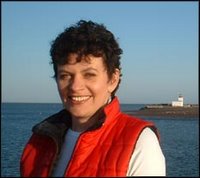
I'm pictured here on a windy day in front of the Cliffs of Moher with Katherine Webster, Director of the Cliffs of Moher Experience 'officially' exchanging apparel from each of our attractions.
So consider also voting for the lovely Cliffs of Moher when you go online to choose your favourite New7Wonders of Nature.
Monday, February 14, 2011
Snow cliffs ~ thick & furious
 Luckily for the Canada Games, now taking place in our region, we've had an unusual amount of snow this winter. The Bay of Fundy is in the 'snow belt' on the east coast of Canada anyway but even still there are many years when the snow comes late and melts early.
This year's significant accumulation makes for some interesting sights as the winter photo series here on my blog illuminates. Top among these sights are steep, craggy Bay of Fundy cliffs blasted with a thick layer of snowy sediment, such as those pictured here.
This lucky shot taken a few days ago in Parrsboro, Nova Scotia: high tide local cove in the foreground and Cape Blomidon - 8km across the Minas Channel - in the distance.
Wednesday, October 13, 2010
North America's 1st UNESCO Geopark announced for Fundy!
 Big news on the geology front in a section of our Bay in New Brunswick: officials with the Global Geoparks Network, a UNESCO program, announced during their annual conference in Greece last week that Bay of Fundy's Stonehammer Geopark will join 76 other parks in 23 countries across the globe!
A geopark is an area that showcases geological features of global importance. UNESCO created the designation program to protect and enhance the value of old landscapes, while educating people about what lies beneath their feet.
The Stonehammer Geopark encompasses 2,500 square kilometres of land, stretching from Lepreau Falls to Norton. Sites within the Geopark include Rockwood Park, Dominion Park, the Hampton Lighthouse River Centre and the Fundy Trail, among others.
One of the really great places to see some of Stonehammer's geological scope is right above Reversing Rapids in Saint John: there's one set of rocks about 500 million years old right beside other rock about a billion years old. See this in our Bay of Fundy Travel Show episode for Reversing Falls.
Congratulations to everyone involved with Stonehammer's designation. Here's hoping that the new it means more interpretation & more opportunities to discover the Bay of Fundy's fascinating geology. Click here to join Stonehammer Geopark's facebook fan page
Monday, October 19, 2009
Columnar basalt? I'm lovin' it!

 It's never too late to become fascinated with geology and, I'll warn you, such a fascination could very well develop during a visit to the Bay of Fundy! We're surrounded by so much cool geology, you just can't help but find it interesting.
Half the time I have no idea precisely what I'm looking at but that doesn't keep me from being randomly awestruck by Fundy's many rocks & rock formations.
For example, take columnar basalt: these vertical columns are long cylinders with many straight sides (sometime appearing hexagonal from the top). They are the result of the quick cool of lava flow.
There are many basalt cliffs around Bay of Fundy but one of the most accessible and visually intriguing is the famous Balancing Rock on Long Island, near Digby. Here a single column of basalt appears to sit 'balancing' precariously atop the edge of another, while another nearby column pushes up to form a flat step beside its neighbouring columns.
These are two photos I took while hiking there this week.
Monday, September 07, 2009
Hole in the Wall & cliff edge camping!

 We're kinda into our edgy cliffs and rock formations here around the Bay of Fundy. Here're some photos I took this week at Hole in the Wall Park & Campground on Grand Manan Island, New Brunswick.
The Hole in the Wall formation itself is only about 10,000 years old ~ carved by the tides from rocks that are probably about 300 million years old. There's awesome coastal hiking and clifftop camping at Hole in the Wall Park. Check out the teensy tiny tent on the green patch in the right picture...gives a whole new meaning to 'camp with a view'!
Thursday, August 13, 2009
44th Annual Gem & Mineral Show
 Here's a longtime Bay of Fundy event happening this weekend in Parrsboro: the Nova Scotia Gem & Mineral Show. It's Canada's oldest gem & mineral event (44 yrs). If you live in the region you may even recall it being called the "Rock Hound Roundup" in the early days - must have attracted too many rock bands and dog clubs because they changed the name about a decade ago!
The show, starting tomorrow and running through the weekend, consists not only of exhibits but also interpreted beach tours, exhibits, workshops, demonstrations, and displays. Check out the list of activities of just about everything you can think of related to gems & minerals:
- gold panning demo
- wire wrapping stones for jewelry
- rock tumbling demo
- glass bead making
- healing properties of stones
- intro to basic principles of geology
- dinosaur painting for kids
- prehistoric spear making & throwing
- assorted jewelry making workshops
plus an evening of Swing with Parrsboro's Elastic Big Band at the Gemcutter's Ball on Saturday night!
The show is a great way to learn more about Bay of Fundy's amazing geology!
Tuesday, August 11, 2009
Happy 150 years to the Origin of Species!
 You may be surprised to learn that the Bay of Fundy is home to some of the most significant scientific discoveries which supported Charles Darwin's theory on evolution.
Darwin was an English naturalist who presented evidence that all species have evolved over time from common ancestors, through the process he termed "natural selection". In 1859, he introduced the concept of it as a principal mechanism of evolution in his book On the Origin of Species. At the time, no one knew the age of the Earth or of milestones in our planet's history.
2009 marks the 150th anniversary of the publication of Darwin's On the Origin of Species by means of Natural Selection, in which the Joggins Fossil Cliffs are referenced. Charles Darwin drew on the completeness of exposure at Joggins and the recurrence of the fossil forests to illustrate that the fossil record was inherently incomplete. Darwin argued that even in the unrivaled exposures at Joggins, the intervening beds theoretically could hide “the fine intermediary gradations which must on my theory have existed between them,” with the result that the fossil record generally gives the misleading appearance of “abrupt, though perhaps very slight, changes of form".
The Joggins Fossil Cliffs (Nova Scotia side of Bay of Fundy) were made a World Heritage Site by UNESCO last year. The cliffs are referred to as a "Coal-Age Galapagos" and are the best place in the world to see fossils from this period.Sunday, May 17, 2009
Kayaking video at Cape Chignecto
Here's a pretty corner of the Bay of Fundy that's been very popular with hikers for awhile but is also one of the best places to kayak in the region: Cape Chignecto Provincial Park, in Advocate Harbour, Nova Scotia.
The folks at Nova Shores Kayak Adventures hosted Reelwater Productions of British Columbia here last fall and ended up with this fabulous footage of kayaking at high tide then walking at low tide of the Three Sisters rock formations off Cape Chignecto Park.
Nova Shores is 'in the water' already for the season (though they have been known to venture out themselves in the winter too - check out this post). Nice and warm here now in Bay of Fundy...!
P.S. check out the whole amazing video "Eastern Horizons: shot by Reelwater in eastern Canada last year!
Monday, April 06, 2009
Images from the real Isle Haute

 Of all the 450+ posts I've made on this blog, one of the most popular with my readers was the post I made last fall about Isle Haute (a small isolated island in the upper part of the Bay of Fundy where the bay splits into Chignecto and Minas Basins). It seemed I wasn't the only person with a 'crush' on this mysterious island that floats out there so visible but not so accessible from New Brunswick and Nova Scotia shores of the Bay of Fundy.
Imagine my delight today when I came across Brian Grant-Paul's Explore Nova Scotia website with it's exquisite insights and images about many corners of our Bay, including Isle Haute. Check out Brian's photos (use with permission) of the island's vertical basalt cliffs and its low-tide-only sandbar, plus more pics on his blog.
Now,more than ever, actively looking for someone with a boat to take me out there this summer!
Monday, March 02, 2009
Ice causeway?
 Some winters I wonder if our Bay of Fundy ice cakes are dense enough to create a floating causeway. There's a story told that there was once a man who hopped across the Minas Basin from Parrsboro to Blomidon on the ice cakes to visit his lady love. On a day like today, when I took this photo, I can actually believe this may have been possible!
Wednesday, June 04, 2008
Amazed (again) by Fundy geology


Although I make a point of checking out Fundy's various geology exhibits, such as those at the New Brunswick Museum, Hopewell Rocks, Fundy Geological Museum and Joggins Fossil Cliffs, there is really nothing quite like taking a guided interpretive hike along the beach at low tide tagging along with someone who knows what they're seeing!
Last week, a visit from an Outpost Adventure Magazine travel writer gave me a great excuse to take a few hours away from the office to take in a Fundy Geological Museum Field Trip with its curator.
We took an awe inspiring walk on the ocean floor alongside about 350 million years of towering basalt and smooth sandstone cliffs. It reminded me that the Bay of Fundy's geological tale is vast; it's about dividing continents, glacial deposits, rift valleys, reefs, tropical sea, desert sands and volcanic flows. Indeed, it's the tale of the Bay of Fundy then and now.
These museum field trips take in various sections of coast around Parrsboro, Nova Scotia, on a regular schedule throughout June, July & August; otherwise for group and school bookings. By the way, such tours are also a very safe way to explore our tidal coast.
Tuesday, April 29, 2008
Sneak peek at new Joggins Fossil Centre

 Although the 'new' Joggins Fossil Centre opens to the public on May 17, I was delighted to receive an invitation to attend its opening ceremony last week. There is much buzz in our region about this very welcome addition to the Bay of Fundy 'product'. My first glimpse of the new centre certainly did not disappoint!! It is a beautifully designed experience both inside and out. Here are some highlights:
- Local stones were layered on the exterior facade to replicate the site's adjacent fossil cliffs
- The site will generate about 60% of its own power through wind turbines & solar, and has some nifty 'green' features like a sod roof & rain water capture.
- The gallery exhibits are really interesting, with lots of interactive design elements like those in the photos as well as glass portholes in the floor, trackways to follow around the museum, interesting multi-media displays, etc.
Thursday, April 03, 2008
Fundy fossil takes a walk....
 Here's a uniquely Bay of Fundy riddle: what's 300 million years old, weighs two tonnes, lived in a basement for 43 years and just made a 50-km trek across the New Brunswick - Nova Scotia border?
Answer: a two metre long fossil of the tracks of an arthropleura - a Paleozoic invertebrate that resembles a giant millipede.
This fossil was discovered by a Mount Allison University (Sackville, New Brunswick) professor in 1964 and has been housed there in a basement storeroom ever since. Yesterday morning it was transferred to its new home at the Joggins Fossil Centre across the border in Joggins, Nova Scotia.
The arthropleura may have had as many as 30 legs and left tiretread-style tracks that can still be seen fossilized in the actual Joggins fossil cliffs. The rediscovered fossil will be displayed in the lobby of the new interpretation centre - opening April 22.
(Photo of movers loading the fossil on to a truck - courtesy of Mount Allison University)
Wednesday, November 28, 2007
Glacial delta exposed!


Now that the pretty leaves have dropped and the blueberry fields have turned from crimson to brown it's the perfect time to look more closely at subtleties of the Bay of Fundy world around us. My home community of Parrsboro, for example, is located on a huge glacial outwash delta that has been carved into four distinct terrace levels. Here's a photo borrowed from the Nova Scotia Dept of Natural Resources. Can you see one of the terraced ridges snaking down the middle? (I've helped you out with the white line on the 2nd pic) Fortunately for us, and the many other post-glacier areas of the Bay of Fundy, these seemingly barren fields turn out to be perfect terrain for wild blueberries. Who knew?
Wednesday, September 19, 2007
Bay of Fundy Island Aerial
 Here's a couple of our Fundy islands from the air - i love the layers of sediment. Great photo from a colleague, Carl Newman, from Florida who 'happened to be driving by' (in the air, that is) on his way to Halifax to have his hurricane hunting aircraft serviced (yes, this is for real!).
The only thing is... I'm embarrassed to say that I'm not quite sure which islands they are...I don't often see the Bay of Fundy from the air so I'm a bit puzzled. I'm thinking they are Two Islands or a couple of the Five Islands in Minas Basin. Got any ideas? Send me a comment using the Comment tab below...!
Wednesday, August 29, 2007
Rapelling at Cape Enrage

Friday, August 17, 2007
Quartz crystals


 One of the neat things about basalt is that other rock seams are sometimes found between its layers. A rough seam of quartz crystals lies exposed at Cape Sharp. Here are some photos I took last weekend (with my hand in there for some perspective). Typically Fundy, I think there might be some agate mixed in there too!
Wednesday, August 15, 2007
Columnar basalt

Probably the best known example of columnar basalt around the Bay of Fundy is Balancing Rock in Tiverton, between Digby and Brier Island, Nova Scotia. It only takes about 15 minutes to hike out to the lookoff. Here it's obvious that the original lava cooled into angular columns. You may have heard of the Giant's Causeway in Ireland - one of the world's amazing places to see hexagonal basalt columns. I haven't been there yet but it's on my list!
Tuesday, August 14, 2007
Molten lava in the Bay of Fundy

Basalt is the most common type of solidified lava on earth; it actually makes up most of the ocean floor. The Bay of Fundy tides, our constant erosion and our complicated geological history result in a good deal of basalt available here to be 'seen'. Previous readers of my blog will recall references to 'basalt headlands' such as the one over my shoulder at Cape Sharp in Sunday's post two days ago. That's is basalt in its craigy, scarpy form. Basalt also presents here in two other ways: as obvious columns and as rock faces smoothed by the tides. I always think that the smooth basalt looks close to its original molten lava form. I snapped this photo at Cape Sharp beach.
Subscribe to:
Posts (Atom)


 Posts
Posts


